AP

AP Biology Exam Prep with an AI Tutor

AP Biology is the College Board's college-level biology course and exam, organised into 8 units from chemistry of life to ecology and scored 1-5. This page lays out each unit's exam weighting, the MCQ-plus-FRQ format, and how OmniTutor's AI tutor converts wrong answers into targeted review.

omnitutor.live
The OmniTutor study hub with the AI prompt bar

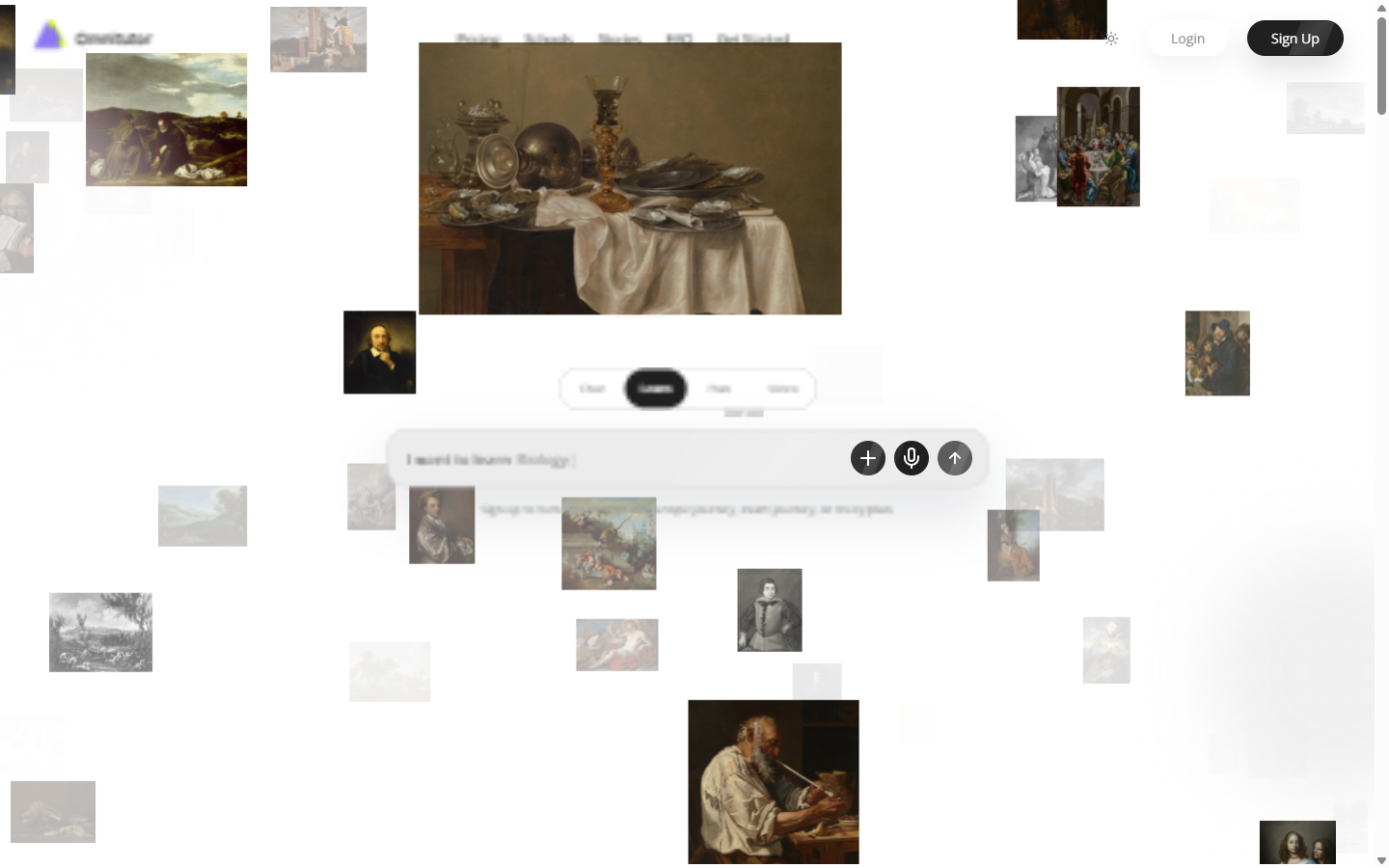
The OmniTutor study hub — ask anything, get a course.

50,000+Learners
1.2MAI lessons
4.9/5Learner rating
28Exams covered

How it works

An AI tutor that actually tutors.

1

Ask anything

Stuck at 11pm before a test? Ask in chat or by voice. Answers are worked to your exam's style — not generic textbook copy.

2

Watch it explained

Every topic can become a short video lesson, generated for your chapter — with real examples and diagrams.

3

Follow a plan that adapts

A daily plan built from your syllabus's weightage. Miss a day? It rebalances instead of guilt-tripping.

The exam is 3 hours: 60 multiple-choice questions in 90 minutes (50% of your score) and 6 free-response questions in 90 minutes — two long FRQs worth 8-10 points each and four short FRQs worth 4 points each.

AP Bio rewards explanation over recall: FRQs ask you to justify with experimental evidence, so practising claim-evidence-reasoning answers matters more than memorising every enzyme name.

What are the 8 AP Biology units and their weightings?

Chemistry of Life (8-11%), Cell Structure and Function (10-13%), Cellular Energetics (12-16%), Cell Communication and Cell Cycle (10-15%), Heredity (8-11%), Gene Expression and Regulation (12-16%), Natural Selection (13-20%), and Ecology (10-15%). Evolution and energy threads run through the whole exam, not just their own units.

Units 3, 6, and 7 carry the heaviest weights, so cellular respiration, photosynthesis, regulation, and selection evidence deserve double practice time. OmniTutor's diagnostic weights your study plan the same way the exam does.
What is the AP Biology FRQ format?

Question 1 is an investigation-style long FRQ with data to analyse; question 2 is a conceptual-design long FRQ; questions 3-6 are short FRQs covering different units. Answers are graded against rubrics that award points for specific claims, evidence, and reasoning — bullet points are fine, but every point needs to be earned explicitly.

Common point-losers: describing when asked to explain, and giving correct biology that does not answer the question. Rubric-feedback practice trains you to match the verb.

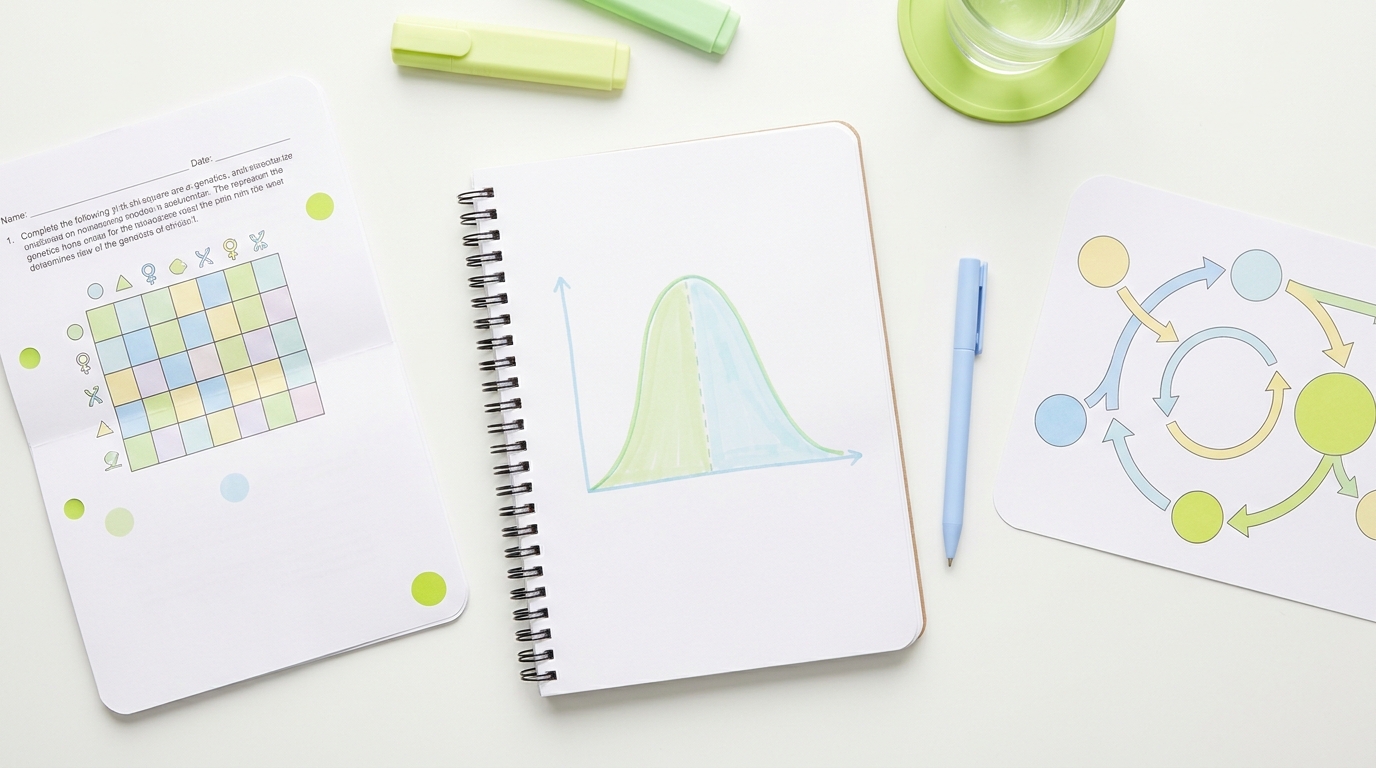
AP Biology study notes with cell respiration and genetics worksheets

Is AP Biology hard without taking honors bio?

It is challenging but doable — AP Bio assumes familiarity with basic chemistry and cell structure rather than prior honors coursework. The volume is the obstacle: 8 units of detailed content with a heavy vocabulary load. Consistent spaced exposure beats cramming.

OmniTutor helps by breaking each unit into whiteboard-style videos and short daily drills, so the vocabulary gets recycled on a schedule your brain can actually keep.

How do you study for AP Biology efficiently?

Anchor on the CED (Course and Exam Description): its learning objectives are literally what MCQs are written from. Build a cycle — learn one topic's objectives, drill MCQs on it, write one practice FRQ — and re-test missed items after 3 days and 2 weeks for retention.

Data-analysis skills (chi-square, graph interpretation, experimental design) appear across every unit and are best practised as their own track; OmniTutor tags these separately so you can drill the skill, not just the topic.

OmniTutor product view

What labs and science practices does AP Bio test?

The exam tests six science practices — concepts analysis, visual representation, questions and methods, representing data, statistical tests, and argumentation — embedded inside content questions rather than as a separate section. You will never be asked to recall a specific wet lab, but you must evaluate methods and data like a scientist.

Practising with data sets and experimental scenarios, as the FRQs present them, covers this; OmniTutor's drills frame thousands of questions this way.

Learners

They kept going. It shows.

★★★★★

Units 4 and 6 were dragging me down until the drills kept recycling cell communication and regulation questions. The FRQ rubric feedback taught me to answer the verb — explain, not describe.
Grace N.AP Bio, scored 5 · ChicagoAP Biology

★★★★★

Chi-square and graph analysis as a separate practice track was genius. Half the exam is reading data confidently and I stopped second-guessing myself.
Sofia R.AP Biology · MiamiAP Biology

★★★★★

Getting a video explanation the moment a concept confused me kept me from falling behind during the hardest semester of high school.
Marcus D.Junior, AP Bio + APUSH · AtlantaAP Biology

Questions

Asked before you did.

Most colleges award credit for a 4 or 5, and many accept a 3 for general education science credit. About 15-17% of students typically earn a 5. Since credit policies vary by institution, check your target college's AP credit table — then aim a point band above the requirement.

AP Bio is broader and vocabulary-heavy; AP Chemistry is more mathematical and abstract. Students strong in reading and systems thinking find Bio easier, while students comfortable with algebra and particles prefer Chem. Both reward FRQ practice over notes-review.

Six: two long free-response questions (8-10 points each) and four short ones (4 points each), all in 90 minutes. The long FRQs usually present novel data to analyse, which is why practising unfamiliar data sets matters more than memorising classic experiments.

No — the exam moved away from name-recall toward function and regulation. Know the handful the CED explicitly lists (like rubisco, ATP synthase, DNA polymerase) at a functional level, and focus your memorization budget on processes, feedback loops, and experimental design instead.

Ask it to explain any confusing concept — like electron transport or operons — at whatever depth you need, at any hour. OmniTutor pairs that with unit-tagged MCQ drills and FRQ feedback, so the explanation lands right where your mistakes are happening.

Start AP prep free tonight.

Free to start, no card needed. Your first AI course is minutes away.

Start free