CBSE

CBSE Class 10 Syllabus 2026-27 and Board Exam Preparation

This page maps the CBSE Class 10 syllabus for 2026-27 across maths, science, social science, English, and Hindi, with the board exam pattern, sample papers, and a preparation timeline. It is for Class 10 students aiming for 90-plus percent and for parents tracking board readiness.

omnitutor.live
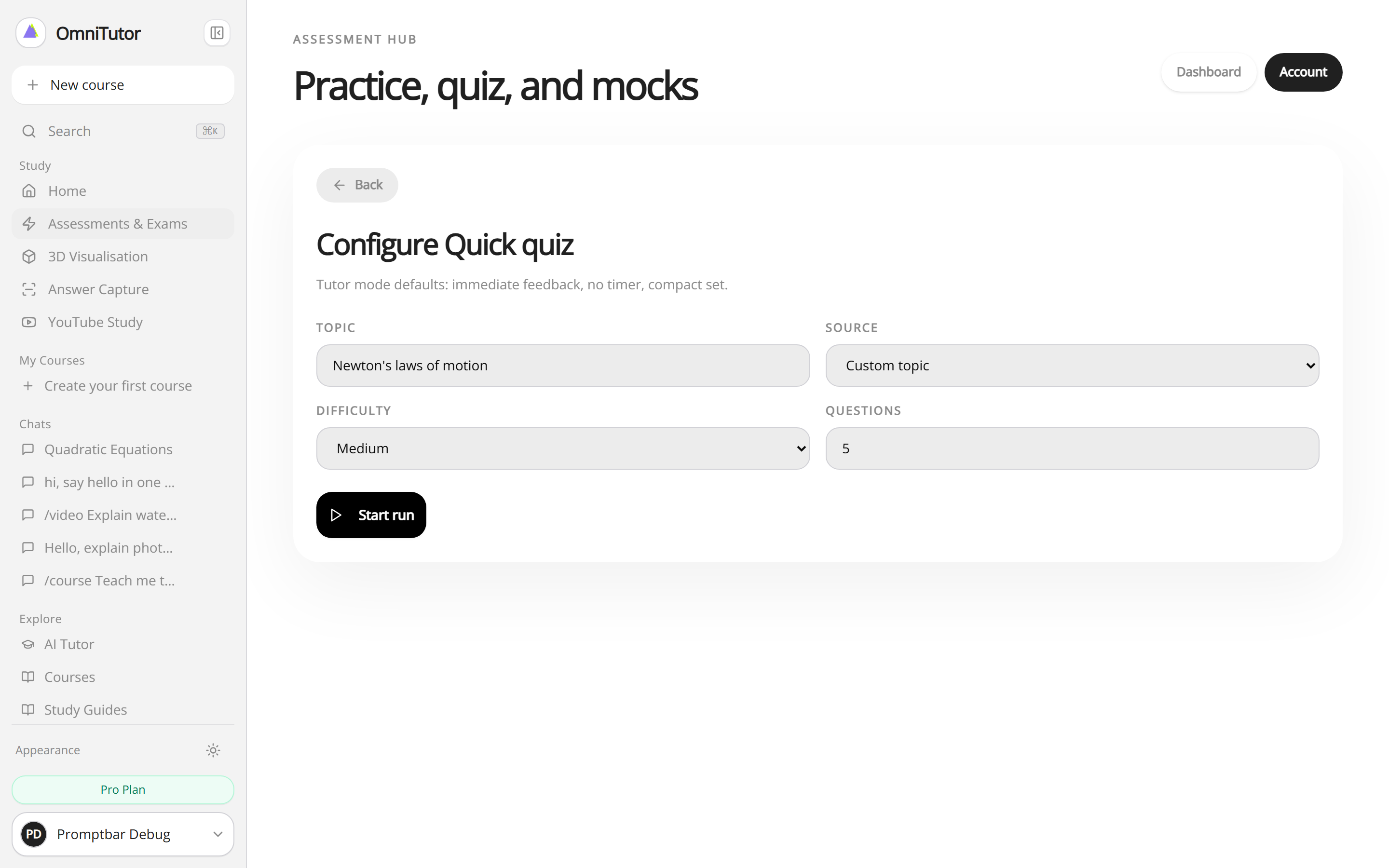
The OmniTutor study hub with the AI prompt bar

The OmniTutor study hub — ask anything, get a course.

50,000+Learners
1.2MAI lessons
4.9/5Learner rating
28Exams covered

How it works

An AI tutor that actually tutors.

1

Ask anything

Stuck at 11pm before a test? Ask in chat or by voice. Answers are worked to your exam's style — not generic textbook copy.

2

Watch it explained

Every topic can become a short video lesson, generated for your chapter — with real examples and diagrams.

3

Follow a plan that adapts

A daily plan built from your syllabus's weightage. Miss a day? It rebalances instead of guilt-tripping.

Since 2026, CBSE holds Class 10 boards twice a year — a main exam in February and an optional second exam in May, with the better score counting. Passing still needs 33 percent in each subject, combining 80-mark theory papers with 20 marks of internal assessment.

OmniTutor converts the syllabus into dated weekly targets, generates chapter notes and videos, and serves sample-paper-style practice with instant checking. Weak chapters resurface as recovery quizzes until pre-boards instead of being quietly abandoned, and full mock papers build the three-hour writing stamina boards demand.

What is the CBSE Class 10 syllabus for 2026-27?

Class 10 carries five main subjects — mathematics (standard or basic), science, social science, English, and Hindi or another Indian language — plus an optional sixth like computer applications or information technology. The syllabus follows the rationalised NCERT textbooks, so the chapter list is shorter than older editions sitting in senior cousins’ cupboards.

Maths has 14 chapters from real numbers to probability; science has 13, from chemical reactions to our environment. Social science runs India and the contemporary world, contemporary India II, democratic politics II, and understanding economic development. English is language and literature through First Flight, Footprints without Feet, and the prescribed grammar and writing syllabus.


What is the Class 10 board exam pattern from 2026?

Each subject is 100 marks: an 80-mark theory paper plus 20 marks of internal assessment — periodic tests, portfolio, and subject enrichment. Passing needs 33 percent in each subject, theory and internal combined. Since 2026, CBSE runs Class 10 boards twice: February for everyone, May for those reappearing to improve.

Around half of every paper is competency-based — case studies, assertion-reason, source-based items — with the rest split between objective and constructed-response questions. The pattern rewards reading the question fully; most lost marks trace to answering what was expected, not what was asked.

CBSE Class 10 board exam preparation with OmniTutor

How should Class 10 board exam preparation be sequenced?

April to November belongs to first-pass learning: chapter done in school, NCERT exercises finished the same fortnight, one test per chapter. December and January are for pre-boards, sample papers, and the first full revision. February is light revision plus past papers under exam timing — not new chapters.

OmniTutor automates that sequencing: enter the exam date, and the plan schedules chapter learning, weekly practice, recovery for weak topics, and mock papers so the peak lands in February. Progress is visible per subject, so social science never quietly waits until the last week.

How do CBSE Class 10 sample papers actually help?

CBSE releases subject-wise sample papers and marking schemes each year on cbseacademic.nic.in — the closest public preview of the real paper, including competency-item styling. Solving them under a three-hour clock trains selection, speed, and the discipline of leaving a 5-mark question that is not coming.

The marking scheme matters as much as the paper: it shows exactly how steps earn marks, which is why students who study the scheme outperform students who only check answers. Grade your own answers against it once a month from December.

OmniTutor product view

Is NCERT enough for Class 10 boards?

For maths and science, NCERT plus NCERT Exemplar covers essentially everything a board paper asks; social science and English are NCERT-only by design. What decides the score is execution depth: every exercise and in-text question solved, not read. Reference books add volume, rarely marks.

One caution: use the current rationalised edition and the 2026-27 syllabus PDF. Chapters deleted in rationalisation still sit in older books and pre-2023 question banks, and preparing deleted content is pure loss. Trust the CBSE syllabus document, not the internet’s collective memory.

What common mistakes sink Class 10 board scores?

Ignoring internal assessment is the classic one — periodic tests and portfolios are 20 marks that students abandon to last-minute scrambling. The others: leaving sample papers until February, skipping map work and diagrams in social science and biology answers, and writing long answers with no structure.

Answer-writing is a trainable skill: point-wise introductions, underlined keywords, labelled diagrams where relevant. Examiners work fast; papers that make marking easy collect marks. Practise one board-pattern answer per subject per week from October and the habit is automatic by February.

OmniTutor product view

How does OmniTutor help with Class 10 boards?

Everything above is product: chapter notes and explainer videos matched to the rationalised syllabus, adaptive practice after each chapter, sample-paper-style mocks in exam-room mode with delayed scoring, and recovery quizzes for every wrong answer. The countdown plan rebalances weekly as pre-boards approach.

Ask for a 90-day pre-board plan or a chapter-level doubt at midnight; both work the same. Voice mode walks through a solution on the whiteboard while you narrate your confusion — closer to a tutor across the table than a search box.

Learners

They kept going. It shows.

★★★★★

Solving the official sample papers against the marking scheme showed I was losing method marks in maths even when answers were right. January mocks took me from 78 to 94.
MeghnaClass 10 student, DelhiCBSE Class 10

★★★★★

The countdown plan scheduled my geography map work instead of letting it pile up. Pre-board scores in social science jumped eleven marks over the December test.
ArjunClass 10 student, JaipurCBSE Class 10

★★★★★

I used to fear assertion-reason questions in science. The case-study and competency-style drills made them feel normal before pre-boards even started.
AnanyaClass 10 student, ChennaiCBSE Class 10

Questions

Asked before you did.

Yes, from 2026. CBSE holds the main exam in February and an optional second exam about two months later for students who want to improve; the better score stands. The second attempt is optional, and schools register students for it.

Both papers cover the same syllabus; Standard assesses at the level needed for mathematics in Classes 11 and 12, while Basic is easier and meant for students not continuing with maths. Only Standard qualifies you to take maths in Class 11 — check this before choosing Basic for an easier February.

Five: maths, science, social science, English, and a second language. Most students add a sixth optional subject such as computer applications, information technology, or a third language. The best-of rule can include the optional subject, so it is worth taking seriously rather than as a filler.

Chapter-adjacent practice should be daily from April; full three-hour sample papers belong from December, after the syllabus is done and pre-boards begin. Two papers a week per subject in January is plenty, provided each one is followed by honest marking against the official marking scheme.

90-plus percent keeps every stream and scholarship door open, but the honest answer is subject-relative: strong maths and science matter for PCM, and consistency across five subjects beats one 99 with a 70. Set a per-subject target in September and track pre-boards against it.

CBSE offers compartment exams within weeks of results, and under the two-cycle system a second main attempt also exists. One failed subject is recoverable; the smarter play is still to not need it — compartment preparation compresses an entire year into six stressful weeks.

Start CBSE prep free tonight.

Free to start, no card needed. Your first AI course is minutes away.

Start free