Class

Class 11 Syllabus 2026-27: Chapters, Notes, and JEE or NEET Prep

This page covers the Class 11 syllabus for the 2026-27 CBSE session — physics, chemistry, mathematics, biology, English, and the stream electives — with chapter lists, notes, and a study plan. It is for students who just chose PCM or PCB and need the year mapped before school and coaching collide.

omnitutor.live
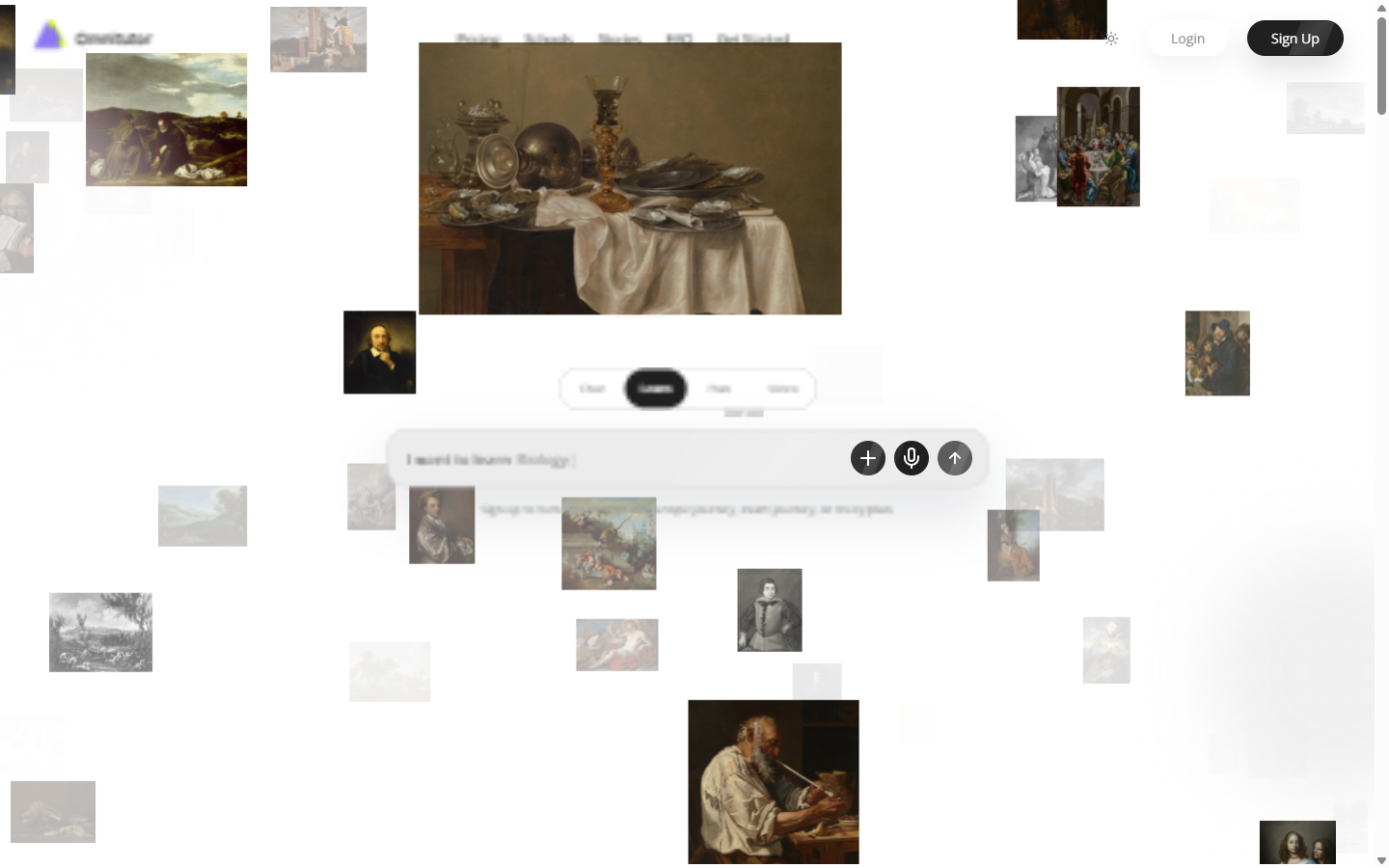
The OmniTutor study hub with the AI prompt bar

The OmniTutor study hub — ask anything, get a course.

50,000+Learners
1.2MAI lessons
4.9/5Learner rating
28Exams covered

How it works

An AI tutor that actually tutors.

1

Ask anything

Stuck at 11pm before a test? Ask in chat or by voice. Answers are worked to your exam's style — not generic textbook copy.

2

Watch it explained

Every topic can become a short video lesson, generated for your chapter — with real examples and diagrams.

3

Follow a plan that adapts

A daily plan built from your syllabus's weightage. Miss a day? It rebalances instead of guilt-tripping.

Class 11 is where difficulty jumps: calculus replaces trigonometry-style computation, rotational mechanics arrives, and organic chemistry begins. There is no board exam, but annual school papers still count, and roughly half of the JEE and NEET syllabus is Class 11 content.

OmniTutor builds one plan that covers school chapters and competitive depth together — a video for the concept, NCERT-level checks for school, and JEE or NEET-level practice where you are ready. Weak chapters get scheduled revision instead of vague intentions.

What is the Class 11 syllabus for CBSE 2026-27?

Class 11 has no board exam; the syllabus is set by CBSE, taught from NCERT, and assessed by school exams. Science students take physics, chemistry, mathematics and/or biology plus English and often a sixth subject like physical education, computer science, or economics. Commerce and humanities streams follow their own subject sets.

Physics runs from units and measurement through kinematics, laws of motion, work and energy, rotation, gravitation, properties of matter, thermodynamics, kinetic theory, oscillations, and waves. Chemistry condenses to nine chapters: mole concept, atomic structure, periodicity, bonding, thermodynamics, equilibrium, redox, basic organic principles, and hydrocarbons.

Mathematics covers sets, relations and functions, trigonometry, complex numbers and quadratic equations, linear inequalities, permutations and combinations, binomial theorem, sequences and series, straight lines, conic sections, 3D geometry, limits and derivatives, statistics, and probability. Biology spans diversity of life, structural organisation, cell biology, plant and human physiology.

How hard is Class 11 compared with Class 10?

The jump is real and it is by design: derivations replace recall, calculus appears in maths and physics simultaneously, and chemistry splits into three distinct disciplines overnight. Students who coasted through Class 10 on cleverness alone meet actual workload around August and never fully catch up.

The fix is structural, not heroic: daily problem practice beats weekend marathons, and clearing a doubt within 48 hours prevents it from becoming a chapter-long fog. Class 11 punishes accumulated backlog more than it punishes slow starters who recover quickly.

Class 11 syllabus chapters and JEE or NEET prep on OmniTutor

How do you start JEE or NEET prep from Class 11?

Start from NCERT and stay ahead of school for one simple reason: roughly half of JEE Main and NEET syllabus is Class 11 content — mechanics and physical chemistry dominate early JEE papers, and Class 11 biology carries a large NEET share. Finish NCERT first, then add one level of competitive practice per chapter.

Sequence matters: master kinematics and laws of motion before rotation; mole concept before anything else in chemistry; trigonometry and functions before calculus. JEE and NEET questions routinely combine two Class 11 chapters, so isolated chapter practice stops working by November.

How do you balance school and coaching in Class 11?

Coaching modules and school exams pull in different directions during school test weeks, and the loser is usually school preparation. Treat them as one syllabus with two formats: the concept is shared, only the question style differs. One integrated calendar beats two competing ones.

Protect two things ruthlessly: sleep and the Sunday planning half-hour where you reconcile coaching homework, school tests, and revision. Drop neither during exam weeks — that is precisely when the calendar is most needed. Students who plan weekly finish November with the syllabus intact.

OmniTutor product view

How does OmniTutor help in Class 11?

Ask for a journey like rotational motion or chemical bonding and OmniTutor builds lessons, whiteboard videos, and practice at two levels: NCERT-accurate for school exams and JEE or NEET-level for competitive depth. Wrong answers generate recovery quizzes on the exact sub-skill that failed.

The plan keeps school tests and competitive milestones on one calendar, resurfaces weak chapters at intervals instead of trusting memory, and shows parents where the year actually stands. Backlog, the Class 11 killer, becomes a visible queue instead of an invisible weight.

What study mistakes hurt Class 11 students most?

Three: skipping NCERT because coaching modules feel superior (school exams and a surprising share of NEET are NCERT-written), avoiding physics numericals by watching solutions, and letting one weak chapter silently become five. The first term is when all three start; the final term is when they bite.

Also common: treating English and the sixth subject as guaranteed marks. They are, until they are not, and a bombed school exam drags both the percentage and stream confidence. An hour a week each keeps them harmless and protects the aggregate that college forms ask for.

OmniTutor product view

Learners

They kept going. It shows.

★★★★★

Rotational motion broke me until the whiteboard video derived moment of inertia for each body shape step by step. I can finally solve rolling-without-slipping problems without guessing.
KabirClass 11 PCM student, PuneCBSE Class 11

★★★★★

The plan lines up my school tests with NEET-style practice on the same chapter, so I stop choosing between the two. Botany unit test and NEET bio quiz in the same week, both survived.
SnehaClass 11 PCB student, PatnaCBSE Class 11

★★★★★

I entered Class 11 with a thermodynamics backlog from July. The recovery queue kept resurfacing it until it was cleared; half-yearly physics went better than my Class 10 finals.
DevClass 11 student, IndoreCBSE Class 11

Questions

Asked before you did.

Substantially, yes. Mechanics, physical chemistry, and a large part of organic chemistry from Class 11 appear directly in JEE, and Class 11 biology and chemistry carry major NEET weight. Competitive preparation that skips Class 11 content is building on half a foundation.

Class 11 is the bigger shock because the style of studying changes; Class 12 is denser but familiar by then. Most students find Class 11 mechanics and organic chemistry the hardest single chapters of the entire two-year stretch. Difficulty peaks at the transition, not at the end.

Four to six self-study hours beyond school and coaching is the sustainable band for serious aspirants, split between problem practice, revision, and backlog clearing. Counting coaching hours as study time is the most common self-deception; only hours with a pen in hand count.

Yes — school exams set most questions from NCERT exercises, in-text examples, and summaries. For chemistry especially, NCERT lines are quoted nearly verbatim. Add NCERT Exemplar for maths and physics stretch, and use coaching modules for competitive formats, not as a school-exam substitute.

Yes, with discipline: finish NCERT biology and chemistry chapter by chapter, add a standard question bank per subject, and take monthly chapter tests. OmniTutor can supply the structured plan, chapter videos, and practice volume; the school provides the lab work and the exam schedule.

Physics, chemistry, biology, and English are fixed, plus a fifth subject — commonly mathematics, psychology, physical education, or biotechnology. Keeping maths with PCB keeps options open for many courses; dropping it narrows a few doors, so decide with the school counsellor, not by workload fear.

Start Class prep free tonight.

Free to start, no card needed. Your first AI course is minutes away.

Start free