Class

Class 12 Biology Syllabus, Weightage, and Chapter Notes

This page covers the Class 12 Biology syllabus for the 2026-27 CBSE boards — reproduction, genetics and evolution, human welfare, biotechnology, and ecology — with unit weightage, NCERT-focused notes, diagrams, and important questions. It is for board students building toward NEET, where this syllabus supplies most botany and zoology questions.

omnitutor.live
The OmniTutor study hub with the AI prompt bar

The OmniTutor study hub — ask anything, get a course.

50,000+Learners
1.2MAI lessons
4.9/5Learner rating
28Exams covered

How it works

An AI tutor that actually tutors.

1

Ask anything

Stuck at 11pm before a test? Ask in chat or by voice. Answers are worked to your exam's style — not generic textbook copy.

2

Watch it explained

Every topic can become a short video lesson, generated for your chapter — with real examples and diagrams.

3

Follow a plan that adapts

A daily plan built from your syllabus's weightage. Miss a day? It rebalances instead of guilt-tripping.

The theory paper is 70 marks plus 30 practical marks, and the subject is diagram-and-definition dense — the marking scheme allots marks to labelled diagrams and exact NCERT terminology. Genetics and evolution is the heaviest unit at 18 of 70.

OmniTutor stages each process on a whiteboard — meiosis frame by frame, transcription and translation animated — then checks recall on the exact NCERT lines exams quote. Diagram labelling drills, spaced revision, and NEET-style MCQs share the same chapter tracks as board practice.

What is the Class 12 Biology syllabus for 2026-27?

Thirteen chapters in five units. Reproduction: sexual reproduction in flowering plants, human reproduction, reproductive health. Genetics and evolution: principles of inheritance and variation, molecular basis of inheritance, evolution. Human welfare: human health and disease, microbes in human welfare. Biotechnology: principles and processes, applications. Ecology: organisms and populations, ecosystem, biodiversity and conservation.

The theory paper is 70 marks plus 30 practical marks, and the subject is diagram-and-definition dense — the marking scheme allots marks to labelled diagrams and exact NCERT terminology. For NEET aspirants this syllabus supplies the majority of biology questions, nearly verbatim from NCERT.

What is the unit-wise weightage for Class 12 Biology?

Genetics and evolution lead at 18 of 70, reproduction carries 14, biology and human welfare 14, biotechnology and its applications 12, and ecology and environment 12. The table below shows the split, indicative for the 2026-27 boards — CBSE publishes the official unit weightage each session.

The planning read: genetics is both the heaviest unit and the one with concepts — linkage, inheritance patterns, molecular biology — rather than pure recall, so it deserves double time. Ecology and human welfare reward tight NCERT reading and repay it quickly, which matters in the last fortnight.

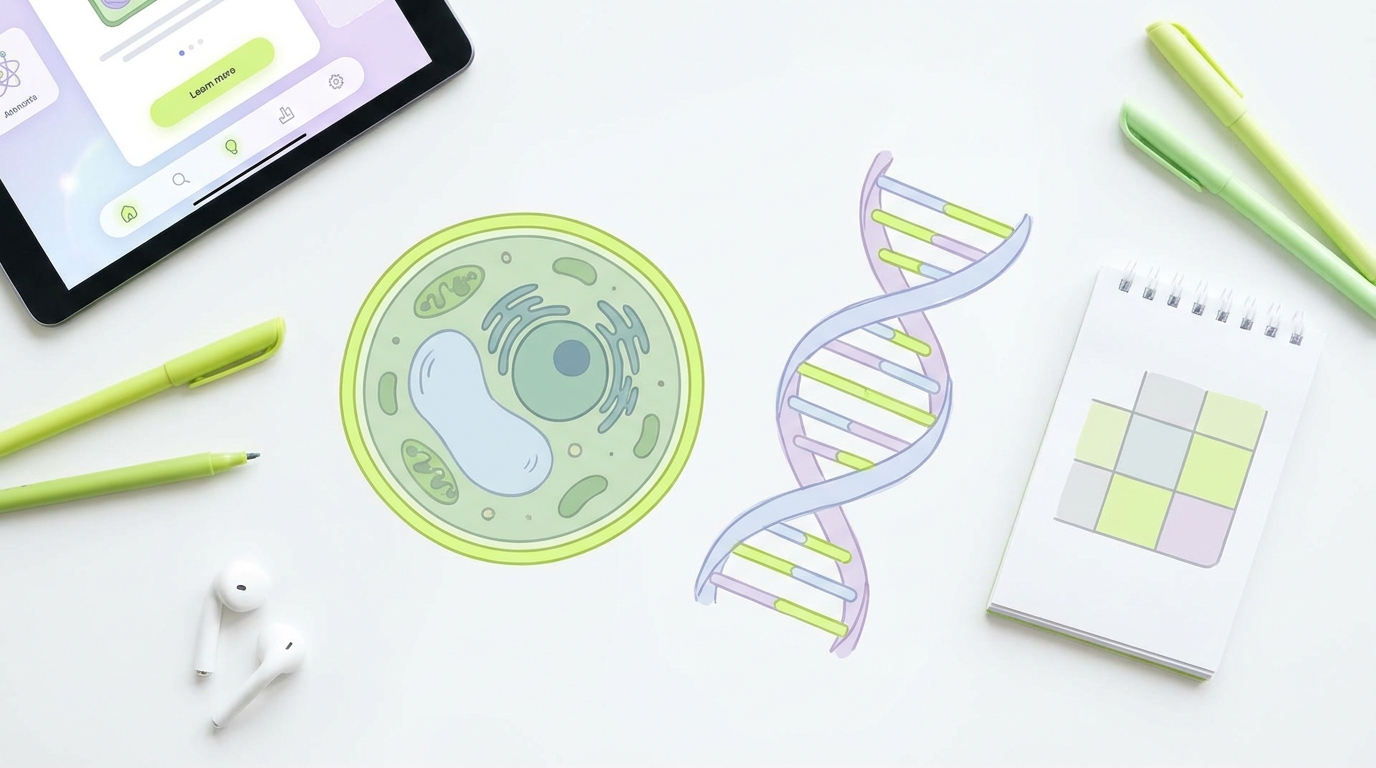
Class 12 biology syllabus and genetics diagrams on OmniTutor

How do you study genetics and evolution for Class 12?

Work the inheritance crosses by hand — Mendel’s monohybrid and dihybrid ratios, test crosses, linkage and recombination numbers — until every ratio carries its mechanism with it. Pedigree analysis answers follow fixed logic: dominant versus recessive, autosomal versus sex-linked; practise the decision tree, not individual answers.

Molecular basis of inheritance is the modern core: DNA replication, transcription, translation, the lac operon, and the human genome project. Draw each process as a labelled flow — boards and NEET both ask for diagrams and order-of-steps questions from this chapter more than any other.

Which diagrams are compulsory to learn in Class 12 Biology?

The recurring set: TS of anther and ovule, embryo sac, human male and female reproductive systems, sperm and ovum structure, DNA replication fork, transcription and translation set-ups, the lac operon, and energy-flow pyramids in ecology. Each is a listed diagram in NCERT and each has appeared in papers across years.

Practise them to exam speed: correct shape, clean labels, no overwriting. An unlabelled diagram earns nothing and a wrongly labelled one earns negative attention — labels are the marks, the artistry is irrelevant. Draw each one five times across the year and the hand remembers.

OmniTutor product view

Is NCERT enough for Class 12 Biology boards and NEET?

For boards, completely — the paper, its diagrams, and its terminology come from NCERT line by line. For NEET, mostly: the bulk of questions are NCERT-level, with occasional application twists that reward having read the text closely rather than summary notes.

Read NCERT biology actively: first pass for narrative, second pass with a highlighter for examinable lines, third pass testing yourself on those lines. The margin summaries and exercise questions are the highest-yield revision material in the subject, ahead of any notes or guide.

How does OmniTutor help with Class 12 Biology?

Processes arrive as whiteboard videos — meiosis staged frame by frame, transcription and translation animated — followed by recall checks on the exact NCERT lines exams quote. Diagram practice includes labelling drills so the marks reserved for labels are trained deliberately, not hoped for.

Board-style long answers, NEET-style MCQs on the same chapters, and spaced revision keep reproduction and ecology facts from fading while genetics gets problem practice. Timed 70-mark mocks with delayed scoring close the loop before pre-boards, with recovery quizzes for whatever they expose.

OmniTutor product view

Learners

They kept going. It shows.

★★★★★

The pedigree-analysis decision tree video fixed what two years of mugging never did. Genetics questions in my pre-board felt like reading instead of guessing.
SanjanaClass 12 PCB student, BhopalCBSE Class 12

★★★★★

Recall quizzes built from NCERT lines meant my board revision and NEET prep were the same work. Biology became the section I bank first in mocks.
VivekClass 12 PCB student, DelhiCBSE Class 12

★★★★★

Redrawing the embryo sac and replication fork until each took under a minute paid off directly — both came as diagram questions in my pre-board.
NaziaClass 12 student, GuwahatiCBSE Class 12

Questions

Asked before you did.

Yes — completely. Board questions, diagrams, and the expected wording come from NCERT directly, and the marking scheme mirrors its sentences. Supplementary books can add structure for notes, but every mark on the paper is reachable from the textbook read line by line.

Enough that diagrams decide the 90-plus band: reproduction and molecular biology questions routinely carry marks for labelled figures. The safe rule is that any structure mentioned in an answer can be asked as a diagram — practise the standard NCERT set until each takes under ninety seconds.

Reproduction rewards structure over repetition: build a stage-by-stage story for each process — spermatogenesis, oogenesis, double fertilisation, seed formation — and draw the accompanying diagram from memory. Mnemonics help for hormone lists; the diagrams carry the marks. Weekly redraws beat monthly rereads.

Mostly. The large majority of NEET biology questions are answerable from NCERT Class 11 and 12 line by line, with a small share testing application or exception recall. Reading NCERT closely plus practising previous NEET papers covers what the exam actually asks.

Thirty-three percent combining theory and practicals, with the practical 30 treated seriously by examiners. The realistic target for science students is far higher — biology is the scoring anchor of PCB, so treat 85-plus as the working minimum rather than the pass mark.

Chapter tests from the start of the session, and full 70-mark papers from December when the syllabus and practicals are done. Two full papers a week in January, each self-marked strictly against the marking scheme, is the standard final-month routine.

Start Class prep free tonight.

Free to start, no card needed. Your first AI course is minutes away.

Start free