Class

Class 12 Chemistry Syllabus, Weightage, and Chapter Notes

This page covers the Class 12 Chemistry syllabus for the 2026-27 CBSE boards — solutions, electrochemistry, chemical kinetics, d- and f-block elements, coordination compounds, haloalkanes through amines, and biomolecules — with weightage, notes, named reactions, and practice. It is for board students and NEET aspirants.

omnitutor.live
The OmniTutor study hub with the AI prompt bar

The OmniTutor study hub — ask anything, get a course.

50,000+Learners
1.2MAI lessons
4.9/5Learner rating
28Exams covered

How it works

An AI tutor that actually tutors.

1

Ask anything

Stuck at 11pm before a test? Ask in chat or by voice. Answers are worked to your exam's style — not generic textbook copy.

2

Watch it explained

Every topic can become a short video lesson, generated for your chapter — with real examples and diagrams.

3

Follow a plan that adapts

A daily plan built from your syllabus's weightage. Miss a day? It rebalances instead of guilt-tripping.

The theory paper is 70 marks plus 30 practical marks assessed at school. Organic carries the largest share, and each branch trains differently: numericals for physical, reaction maps for organic, spaced recall for inorganic — one study method for all three is the classic mistake.

OmniTutor draws organic mechanisms electron by electron, checks physical-chemistry numericals with units at every step, and keeps inorganic facts alive with spaced recall cards. Board-style, NEET-style, and JEE-style practice share the same chapter tracks.

What is the Class 12 Chemistry syllabus for 2026-27?

Ten chapters after rationalisation: solutions, electrochemistry, chemical kinetics, d- and f-block elements, coordination compounds, haloalkanes and haloarenes, alcohols phenols and ethers, aldehydes ketones and carboxylic acids, amines, and biomolecules — examined in a 70-mark theory paper plus 30 practical marks assessed at school.

Rationalisation removed whole chapters that still haunt old notes: solid state, surface chemistry, general principles of metallurgy, p-block elements, polymers, and chemistry in everyday life are no longer in the syllabus. Studying them is time donated to topics the paper cannot ask.

How are the 70 marks split across physical, organic, and inorganic?

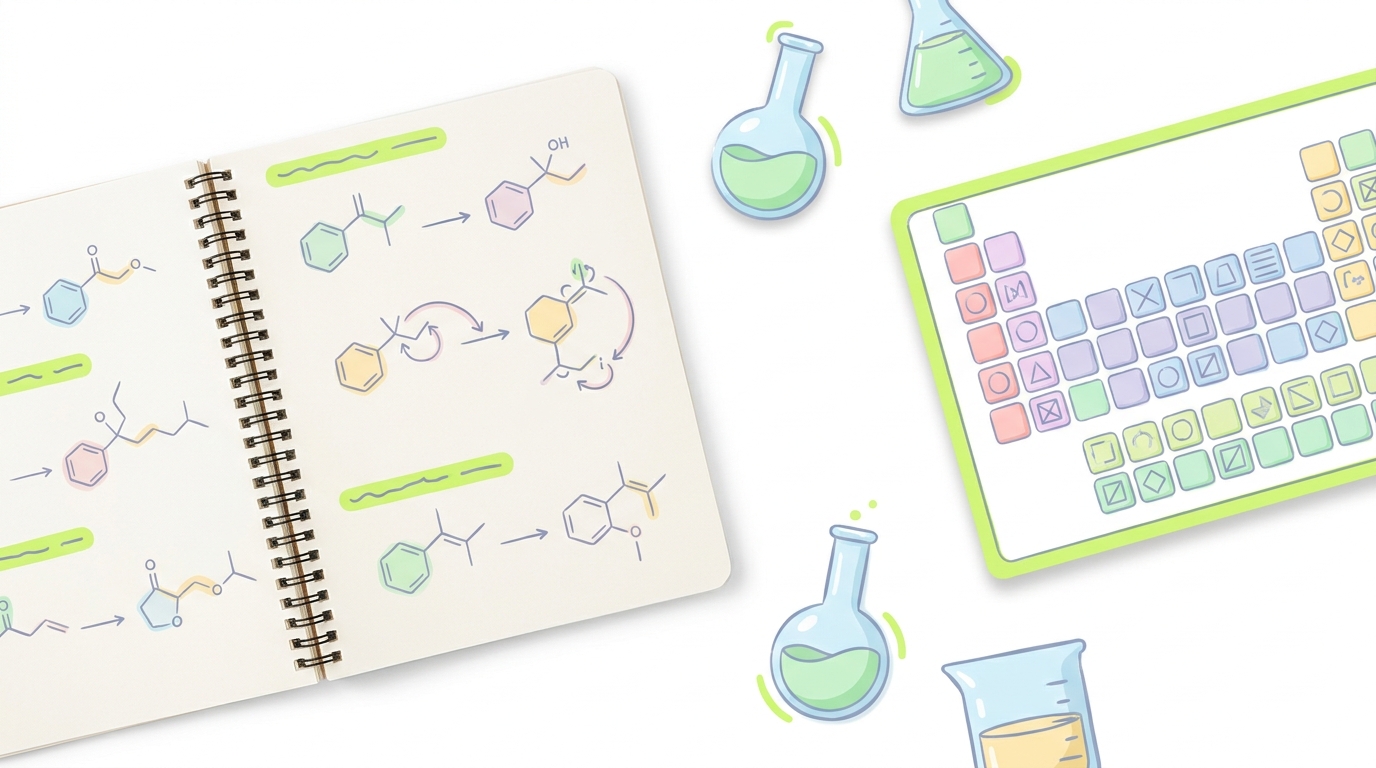
Indicatively, organic chemistry (haloalkanes through amines plus biomolecules) carries the largest share at around 28 of 70; physical chemistry (solutions, electrochemistry, kinetics) around 23; and inorganic (d- and f-block plus coordination compounds) around 19. The table below shows the branch split for the 2026-27 boards.

Each branch studies differently: physical rewards numerical reps, organic rewards reaction maps, inorganic rewards recall. The mistake is using one method for all three — reading organic instead of drawing mechanisms, or memorising kinetics instead of solving rate problems that are pure arithmetic.

Class 12 chemistry syllabus and named reactions practice on OmniTutor

How do you master organic chemistry in Class 12?

Build one reaction map per functional group and update it weekly: haloalkane to alcohol to aldehyde to acid to amine, with reagents on the arrows and conditions underneath. Then drill named reactions — Sandmeyer, Finkelstein, Swarts, aldol condensation, Cannizzaro, Clemmensen, Wolff-Kishner, Rosenmund, Gabriel phthalimide — until each is automatic.

Distinction tests earn easy marks: Tollens and Fehling for aldehydes, Hinsberg and carbylamine for amines, iodoform for methyl ketones. Practise writing conversions as two-step sequences — boards love convert-A-to-D questions that are just two named reactions chained together. Word the reagents above the arrow exactly as NCERT does.

Why do coordination compounds matter in boards and NEET?

Coordination compounds blend nomenclature, isomerism, valence bond hybridisation, and crystal field theory into one consistently examined chapter. IUPAC naming alone appears almost every year, and CFT splitting diagrams for octahedral and tetrahedral fields are standard fare in both boards and NEET.

d- and f-block pairs with it: electronic configurations, oxidation states, lanthanoid contraction, and periodic trends. Both chapters reward line-by-line NCERT reading more than any reference book — the examiners quote the textbook almost verbatim. Flashcard-style recall at spaced intervals is the efficient route through both.

OmniTutor product view

Which numericals appear from physical chemistry in Class 12?

Raoult’s law and colligative properties from solutions (elevation, depression, osmotic pressure), the Nernst equation, conductivity and Kohlrausch’s law from electrochemistry, and rate laws, half-life, and Arrhenius from kinetics. Each is a formula pattern that repeats with new numbers — perfect for drilled practice.

Unit discipline decides the marks: molarity to molality conversions, faradays, and kelvin temperatures are where answers die. Practise with units written through every line for a month and the errors disappear on their own, which frees attention for the chemistry itself.

How does OmniTutor help with Class 12 Chemistry?

Organic mechanisms are drawn electron by electron on the whiteboard, then tested with reaction-mapping and distinction-test drills. Physical chemistry gets numerical practice with unit checks at every step, and inorganic gets spaced-recall cards — because three branches need three training methods.

Board-style structured answers, NEET-style MCQs, and JEE-style numericals share the same chapter tracks, with recovery quizzes scheduled for every miss and 70-mark mocks in exam-room mode before pre-boards. Nothing about the exam should feel new by then, which is the entire point of a mock.

OmniTutor product view

Learners

They kept going. It shows.

★★★★★

SN1 versus SN2 finally made sense when the video moved the electrons with arrows step by step. Mechanism questions stopped being guesswork in pre-boards.
MeeraClass 12 student, JaipurCBSE Class 12

★★★★★

Nernst equation and Kohlrausch numericals with units checked at every step cleaned up my physical chemistry. Electrochemistry was my top section in the last mock.
AbhishekClass 12 student, LucknowCBSE Class 12

★★★★★

The spaced recall cards for d-block and coordination compounds kept the inorganic facts alive between maths sessions. My pre-board chemistry crossed 90 for the first time.
LubnaClass 12 student, SrinagarCBSE Class 12

Questions

Asked before you did.

Yes, and for inorganic and biomolecules it is essentially the question bank — examiners quote textbook lines. For physical chemistry add exemplar numericals and for organic add conversion and distinction practice. Previous years’ papers confirm the pattern every single year; thick reference books mostly do not.

Group by what they do, not by chapter: reductions (Clemmensen, Wolff-Kishner, Rosenmund), oxidations, substitutions (Sandmeyer, Finkelstein, Swarts), and carbon-chain builders (aldol, Gabriel). Then write each from memory weekly — recall, not recognition, is what the paper pays for in the exam hall.

Yes — SN1 and SN2 pathways, their stereochemistry, and the factors that favour each are part of haloalkanes and haloarenes and appear in boards and NEET both. Draw the mechanism with arrows; written descriptions alone lose the marks reserved for correct electron movement.

A steady chapter of about seven marks: carbohydrates, proteins, vitamins, and nucleic acids, almost entirely factual from NCERT. Two focused readings plus one recall pass before exams is usually full marks — it is the highest marks-per-hour chapter in the paper.

Thirty marks: salt analysis, titration-based volumetric analysis, content-based experiments, the record file, and a short viva. Salt analysis is the make-or-break — the systematic group separation must be memorised as a flow, and practising full analyses before January removes the panic.

Directly — NEET chemistry is built on these NCERT chapters, with inorganic and biomolecules lifted nearly line by line and physical chemistry asked as formula numericals. Board-level thoroughness plus MCQ speed practice on the same chapters is the standard NEET chemistry recipe.

Start Class prep free tonight.

Free to start, no card needed. Your first AI course is minutes away.

Start free