
GCSE

GCSE Maths Revision and Exam Prep

GCSE Mathematics (England, Wales, Northern Ireland) is graded 9-1 across three papers — one non-calculator and two calculator — each 1 hour 30 minutes and a third of the final grade, at either Foundation (grades 1-5) or Higher (4-9) tier. This page maps the topic weightings and the revision approach that moves grades fastest.

omnitutor.live
The OmniTutor study hub with the AI prompt bar

The OmniTutor study hub — ask anything, get a course.

50,000+Learners
1.2MAI lessons
4.9/5Learner rating
28Exams covered

How it works

An AI tutor that actually tutors.

1

Ask anything

Stuck at 11pm before a test? Ask in chat or by voice. Answers are worked to your exam's style — not generic textbook copy.

2

Watch it explained

Every topic can become a short video lesson, generated for your chapter — with real examples and diagrams.

3

Follow a plan that adapts

A daily plan built from your syllabus's weightage. Miss a day? It rebalances instead of guilt-tripping.

Content spans six strands: Number, Algebra, Ratio and Proportion, Geometry, Probability, and Statistics. Algebra and proportion questions dominate the Higher papers' top-grade territory.

Grade boundaries move yearly, but on Higher tier a grade 9 typically needs around 80%+ and a grade 4 (standard pass) around 25-30% — which is why strategic topic choice matters as much as effort.

What are the GCSE Maths exam papers?

Three papers of 80 marks each: Paper 1 without a calculator, Papers 2 and 3 with. Every paper can assess anything from the tier's specification, so interleaved practice beats revising topic-by-topic in isolation. Edexcel, AQA, and OCR differ in style more than content.

Common strategy error: over-preparing easy Number topics while avoiding algebra, which caps Higher-tier grades. A diagnostic-first plan targets the strands that actually move your grade.

How do you get a grade 9 in GCSE Maths?

Grade 9 is awarded to roughly the top 3-4% of the cohort. It demands near-full marks on standard questions plus reliability on the 'problem solving' questions at the paper's end — multi-step, unfamiliar-context tasks combining algebra with geometry or ratio.

The training method: past papers under time, honest marking against the scheme, then re-attempting every lost mark after 48 hours. OmniTutor automates this loop and keeps re-serving your error types until they are gone.

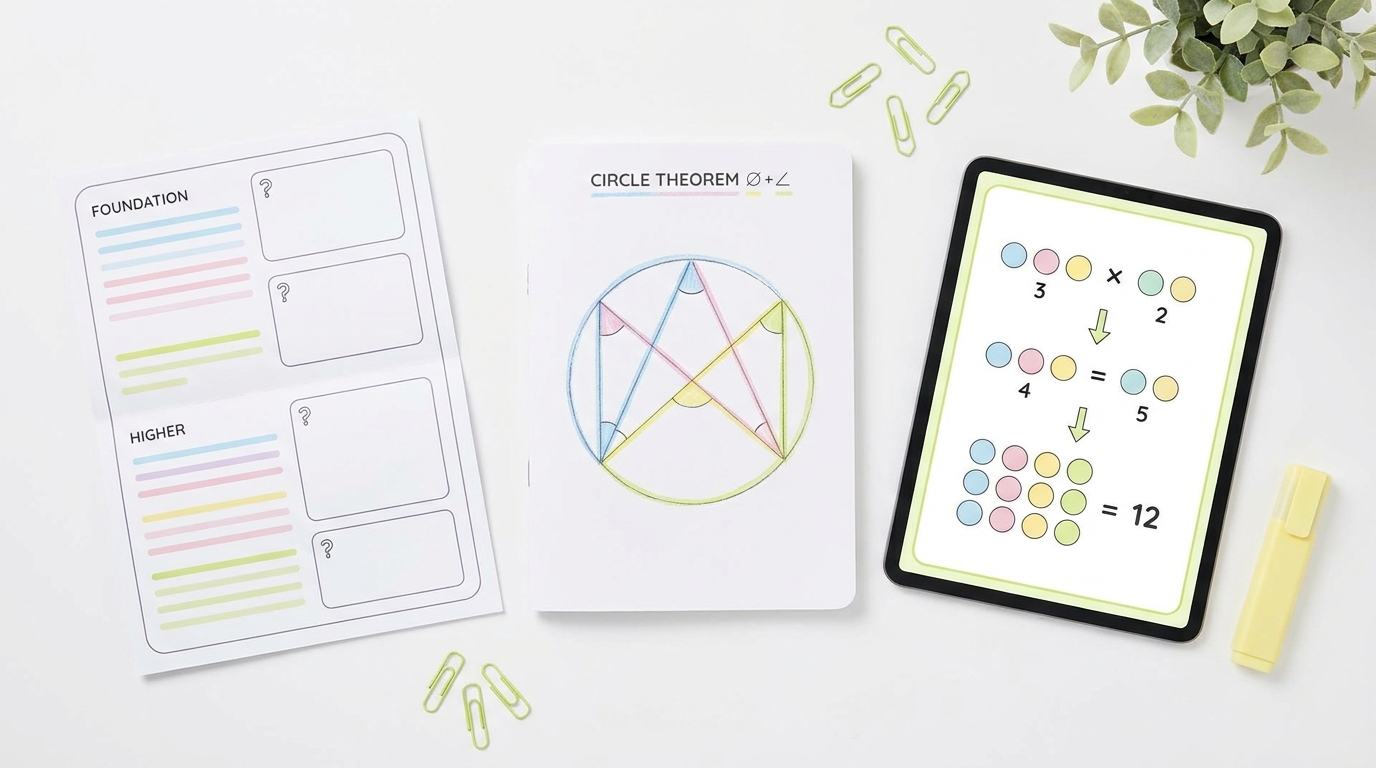
GCSE maths revision desk with circle theorems and graded worksheets

How do you pass GCSE Maths at Foundation tier?

A grade 4 needs roughly half the marks. The highest-yield topics are the ones examiners reuse every series: fractions, percentages, ratio, angles, perimeter/area/volume, and basic probability. Fluency in these alone typically secures a pass.

Show working on every question — method marks rescue wrong answers, and Foundation mark schemes are generous with them. OmniTutor's step-checked practice builds that habit question by question.

Which GCSE Maths topics carry the most marks?

Across recent series, the big four clusters are: standard algebra (forming and solving equations, sequences, graphs — often 20%+ of Higher papers), proportion and percentage problem solving, geometry (angles, Pythagoras, trigonometry, circles), and statistics/probability combined.

Number skills underpin everything and are worth solid direct marks, especially on Foundation. A topic-by-topic marks audit of your last two mock papers tells you exactly where your biggest upside lives.

OmniTutor product view

How early should you start GCSE Maths revision?

Start light in Year 10 autumn — weekly interleaved quizzes, nothing heroic. From Year 11 autumn, move to fortnightly full papers; from February, weekly. Cramming from Easter works only for students already fluent in algebra basics, and costs sleep exactly when memory consolidates.

OmniTutor's plan stages this automatically: fluency drills first, paper conditioning second, error-led re-testing throughout.

Learners

They kept going. It shows.

★★★★★

Grade 8 to 9 is all about the final problem-solving questions. Drilling those exact question types got me the last few marks I needed.
Poppy H.GCSE grade 9 maths · BristolGCSE Maths

★★★★★

I was a solid 5 until the weekly paper cycles started. Honest marking against the scheme showed me I was losing method marks everywhere — that habit change alone lifted a grade.
Tyler B.Higher tier, grade 7 · CardiffGCSE Maths

★★★★★

Algebra used to make me freeze. The step-by-step video for every wrong answer turned it into my favourite topic by February.
Aisha R.Year 11 · LeicesterGCSE Maths

Questions

Asked before you did.

A grade 4 is the standard pass. On Foundation it needs roughly half the marks across the three papers; on Higher around 25-30% historically — exact boundaries shift each series. If you are borderline, securing full fluency on Number, ratio, and geometry basics is the safest path to those marks.

Higher if you are working at a strong grade 5+ and need grades 6-9 for sixth-form entry; Foundation caps you at grade 5 but makes a pass far more accessible. Ask for your school's mock data and target — a confident 5 on Foundation beats a stressed 3 on Higher.

Most grade-8/9 students complete 15-25 full papers before the real series, every one marked against the scheme with errors re-tested. Quality of review matters more than the count — one paper properly dissected beats three skimmed. OmniTutor keeps the error ledger for you.

A scientific calculator from your board's permitted list — the Casio fx-83GT/85 series is the standard. Learn its fraction, prime-factorisation, and table modes early: calculator fluency is worth real time on Papers 2 and 3, and checking answers numerically saves careless-mark losses.

Yes — instant explanations of any homework or past-paper question, unlimited practice at your exact level, and marking that shows where method marks are lost. For students without a tutor at home, OmniTutor provides the daily feedback loop that raises grades fastest.

Start GCSE prep free tonight.

Free to start, no card needed. Your first AI course is minutes away.

Start free