IB

IB Physics (HL & SL) Exam Prep

IB Physics is the Diploma Programme's experimental science course, offered at Higher Level (240 hours) and Standard Level (150 hours), assessing mechanics through quantum physics with an emphasis on data analysis and uncertainty. This page covers the paper structure, the data booklet's role, IA expectations, and how OmniTutor fits each.

omnitutor.live
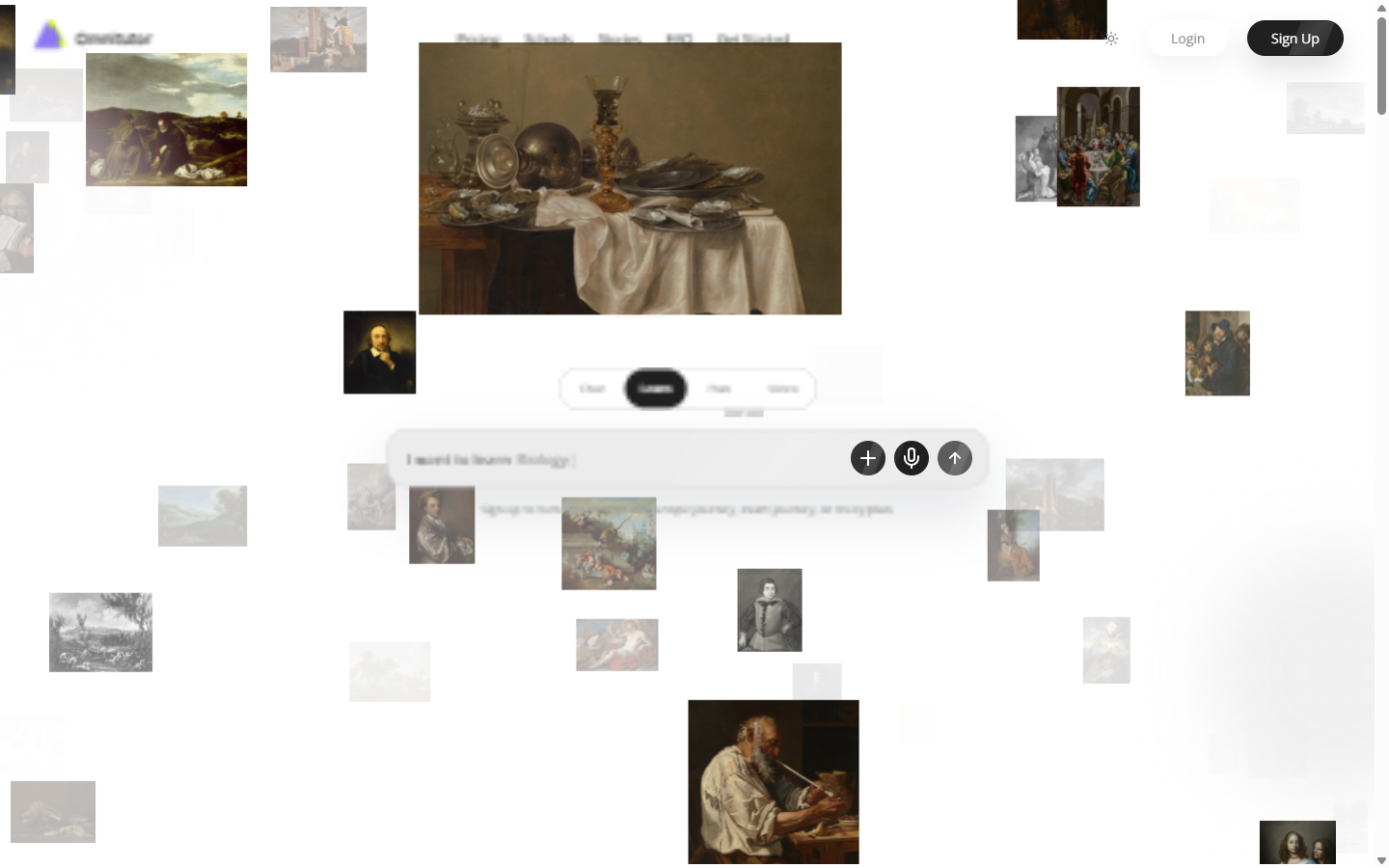
The OmniTutor study hub with the AI prompt bar

The OmniTutor study hub — ask anything, get a course.

50,000+Learners
1.2MAI lessons
4.9/5Learner rating
28Exams covered

How it works

An AI tutor that actually tutors.

1

Ask anything

Stuck at 11pm before a test? Ask in chat or by voice. Answers are worked to your exam's style — not generic textbook copy.

2

Watch it explained

Every topic can become a short video lesson, generated for your chapter — with real examples and diagrams.

3

Follow a plan that adapts

A daily plan built from your syllabus's weightage. Miss a day? It rebalances instead of guilt-tripping.

HL students sit Paper 1 (1h, 40 MCQ), Paper 2 (2.5h, extended problems), and Paper 3 (1.5h, option + data analysis); SL mirrors this at shorter lengths. The internal assessment — your scientific investigation — is worth 20%.

IB Physics scores come from method marks: correct physics with a wrong significant-figure or unit treatment bleeds points. Step-checked practice is the highest-leverage habit.

What is the IB Physics HL paper structure?

Paper 1 is 40 multiple-choice questions in 1 hour (20%); Paper 2 is 2.5 hours of short and extended-response problems (36% at HL) and is where most marks are won or lost; Paper 3 (1.5 hours, 20%) covers data-and-data-analysis questions plus your option topic ( HL options: relativity, engineering physics, imaging, or astrophysics).

The IA investigation carries the final 20%. At SL the shape is identical with shorter papers — 30 MCQs, 1.5h Paper 2, and a 1h Paper 3.
How do you actually use the IB Physics data booklet?

The booklet is provided in every paper — the skill is fluent retrieval, not memorisation. Top students annotate a copy during revision: what each symbol means, when each equation applies, and which ones are missing (notably, some definitions and derived forms must be known).

Practice with the booklet open from day one. OmniTutor's drills assume booklet availability and instead train selection — which of four similar energy equations fits the situation — which is what Paper 2 actually tests.

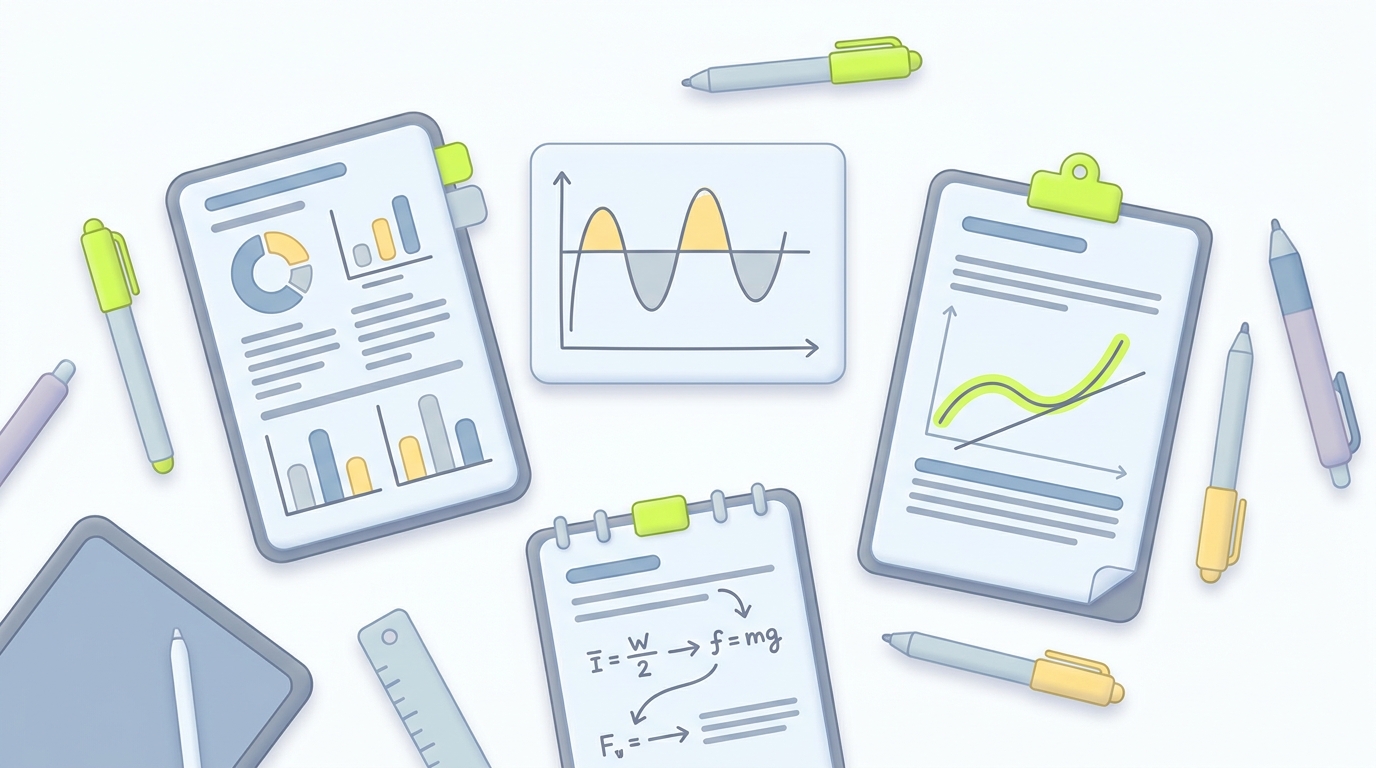
IB physics notes with data booklet, SHM graphs and lab annotations

What makes a good IB Physics IA?

The IA is a self-designed investigation (6-12 pages) graded on research design, analysis, methodology, and communication — with personal engagement reflected throughout. Examiners reward a focused research question, sufficient repeated trials, proper uncertainty propagation, and a linked conclusion-extension loop.

Common failure modes: too-ambitious apparatus, single trials, and conclusions ignoring uncertainties. OmniTutor helps you pressure-test your design, check your uncertainty maths, and tighten the written analysis before deadlines.

How should you revise IB Physics?

Rebuild each topic from the syllabus statements — thermal, waves, fields, electromagnetic induction, quantum — then immediately apply to past Paper 2 questions rather than rereading notes. Keep an error ledger split into physics errors (wrong principle), execution errors (algebra, units, sig figs), and reading errors.

From 6 weeks out, alternate full timed Paper 2s with topic intensives on your two weakest areas. OmniTutor automates the ledger — tagging every miss — and re-serves it until the pattern dies.

OmniTutor product view

Is IB Physics HL harder than AP Physics?

They differ in shape: IB HL covers more breadth with data analysis and an IA, while AP Physics C goes deeper with calculus. IB's marking is unforgiving on working and units; AP's curves differ by exam. For the Diploma's science requirement with mathematical depth, HL Physics is the traditional choice — and the most rewarding with disciplined past-paper practice.

Learners

They kept going. It shows.

★★★★★

Paper 2 data-based questions are a skill of their own. Drilling them by unit moved my score from a 4 to a 6 between mocks.
Emma B.IBDP, HL physics · AmsterdamIB Physics HL

★★★★★

My IA survived because the uncertainty propagation got checked line by line. The feedback on linking conclusion to limitations is exactly what the criterion asks for.
Liam C.IBDP graduate, 40 points · MelbourneIB Physics HL

★★★★★

Annotating the data booklet while drilling made retrieval automatic. Paper 1 went from a rush to comfortably finished.
Aiko T.Physics SL · OsakaIB Physics SL

Questions

Asked before you did.

It is routinely in the conversation with Maths AA HL. The combination of breadth (mechanics to quantum), mathematical demand without calculus, and strict mark-scheme treatment of working makes consistent past-paper practice non-negotiable. Students who keep an error ledger typically climb a grade band by mocks.

The best IAs take a simple, measurable phenomenon and interrogate it thoroughly — damping of a pendulum, cooling curves, refractive index variation, terminal velocity in fluids. Depth of analysis beats novelty: examiners want controlled variables, repeated trials, propagated uncertainties, and an honest conclusion that references them.

Yes — the data booklet is provided for all papers. But it gives equations without context: selecting the right one, handling vector components, and managing units remain your job. Practising with the booklet from the start builds the retrieval speed that Paper 1's 90 seconds per question demands.

Typically around 70-75% aggregated across papers and IA, varying by session. Because Paper 2 mark schemes award method stages, students often gain more from polishing working habits than from learning extra content. Grade boundaries are published per session by the IB.

Step-checked numerical practice that mirrors mark-scheme staging, instant explanations for any stuck concept, data-booklet-style drills, and IA support from research question to uncertainty analysis. The study plan adapts weekly around your error ledger.

Start IB prep free tonight.

Free to start, no card needed. Your first AI course is minutes away.

Start free